|
|
|
crankscraper, crank-scraper, crank-scrapper, crank, crankshaft, rod-bearing, main-bearing, connecting-rod, counterweight, piston, windage, windage-tray, windage-cloud, oil pan, oil-pan, oil-aeration, oil-foaming, oil-cloud, racing, drag racing, road racing, drag-race, road-race, road-course, drift, drifting, time-trial, performance, power, horsepower, HP, torque, TQ, friction, vacuum, economy, engine, motor
|
Porsche
|
Kibort Effect
Kibort Effect understeer https://youtu.be/POkpzS4GCGg
Kibort Effect neutral https://youtu.be/bmHe6pBR-10
Kibort Effect oversteer https://youtu.be/Q-VMhGKo2oc
There is one driver, probably alone in the world, that successfully tracks the stock wetsump 928 with excellent long term survival, Mr. Mark Kibort.
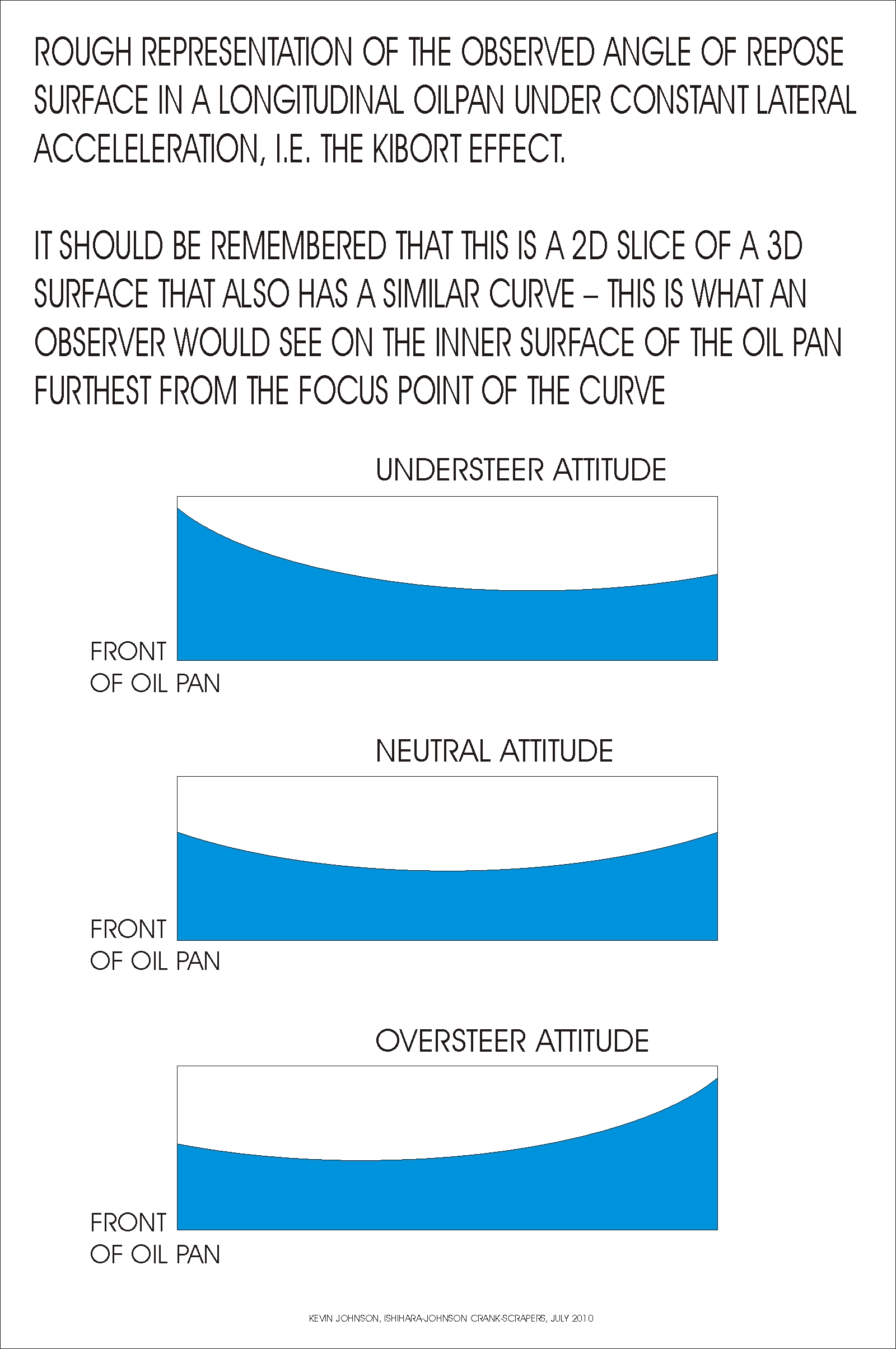
His style of driving in turns makes the oil tend to pool in the forward corner of the engine where the aeration is great but sufficiently allowed for by the Porsche engineers. When a driver's style tends to oversteer then the oil pools in the rear corner where it is violently trapped by the rotating assembly and the engine will eventually expire via the classic 2/6 rod failure. Depending on the rotation and front to rear orientation of the engine (hydroplanes running a rear facing 2.3 Ford can be different, for example) this will usually be in the left rear corner -- as you face the front of the motor (clockwise rotation of the engine) -- during extended high-G left hand turns (from the perspective of the driver's seat).
The Kibort Effect can be illustrated by partially filling a rectangular container of water and placing it on a turntable. You can adjust the attitude of the container to reflect oversteer or understeer of the chassis hence the motor in a longitudinal mounting.
The prevailing lateral acceleration vector will react against the walls of the sump providing a component that will push the bulk of the oil to the front or rear corner of the pan. The pushing of the oil to the front is counterintuitive. The pattern makes an interesting catenoid curve that typically shows at least some oil pushed to the front even in oversteer conditions.
The Kibort Effect is important in that any number of other engines and vehicles can benefit from its insight in wet- and dry- sump design.
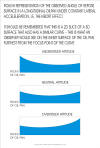
Current state-of-the-art multi-axis dyno simulations used by OEMs and consulting engineering services cannot accurately model/demonstrate the Kibort Effect. For example, in the multi-axis dyno recently performed for Porsche by AVL Schrick*, the simulation cannot accurately show oil flow patterns in a system that is itself under acceleration with a centripetal component. Moreover, the attitude of the car, thereby the engine, is still a further complication. This is a limitation of static water displacement/angle-of-repose/surface-angle tests in pans, as well. The dynamic surface will generally be a complex concave curve/shape.
* Schrick, member of AVL Group:
This is an extremely important video taken by Louie Ott of the
interior of the cam cover of a Porsche 928 on a track back in 2003.
https://youtu.be/KK50k7cbDiQ
Louie's website is no longer active but here is an Internet Archive link to his original comments on the video:
https://web.archive.org/web/20150930004816/http://www.performance928.com/cgi-bin/page_display.cgi?page_nav_name=oilcontrol7DX&pass_parent=1128
|
|
 World Wide!