|
ALLPAR.COM can help you with loads of information about your Mopar!

Here are some links of both discussions and articles written by Mike Holler. He has some really interesting ideas regarding how to make more power without radical modifications.
http://www.allpar.com/fix/holler/
UPDATED 1-15-2010
Distributor Gears in the Slant Six
Periodically the question arises as to why a fitment procedure is needed for OEM and aftermarket distributor gears in the Slant Six. This procedure involves drilling a new hole in the shaft for the single roll pin. It is helpful to first step back and look at the general situation with replacement drive gears and then to look at the slant six situation in particular.
Many replacement drive gears are supplied pre-drilled and are intended to be installed re-using the originally drilled hole on the shaft. However it is clear that for certain engines there have been issues with improperly located holes. This was and is an industry wide problem. Indeed, Ford calls out this reason specifically in its Ford Racing catalog fitment comments:
Quote from the 2008 Ford Racing catalog, page 149: "New and remanufactured distributors with the gear installed at the wrong height."
To illustrate the general confusion in the industry, MSD gives a measurement to the surface of the gears while the specification from Ford is to the end of the gear boss. Multiply this by any number of suppliers to the OEMs.
It should be understood that once an improperly made distributor is released to the consumer as OEM or aftermarket equipment from then forward the service technician cannot assume that the original hole was correctly drilled. In fact, this may be exactly why the replacement gear needs to be fitted.
With respect to the Slant Six, there is interesting information available to the public that points to an error made either in the design stage or very early manufacturing period. It is also possible that this situation was intended but this seems unlikely.
The image below from Allpar.com shows a 1960 rendition of the Slant Six by the art department at Chrysler. If this photo is magnified, it can clearly be seen that two roll pins were used to secure the gear to the shaft.*

Many people have pointed out that the 1960 Factory Service Manual itself lays out the procedure for installing the service gear and the service gear has but one hole. Clearly there was an issue extremely early in the life of this engine and it is highly likely that it involved the elimination of one of the drive pin drillings. It appears that the service gears were drilled for one while the OEM distributor shafts were drilled with the other. Whether this was in error or deliberate is unknown. If it was an error, just as with Ford, if even a limited number of these improperly made parts were released, from then forward it must be assumed that the drilling is incorrect and a refitment procedure outlined.
* Many people have never seen a parallel double roll pin installation to secure a part to a shaft. In fact, it is a common automotive OEM technique used on many parts such as from transmissions.
Here is a picture of a replacement gear superimposed onto the above drawing: [Both pictures have been rotated to allow a better comparison.]

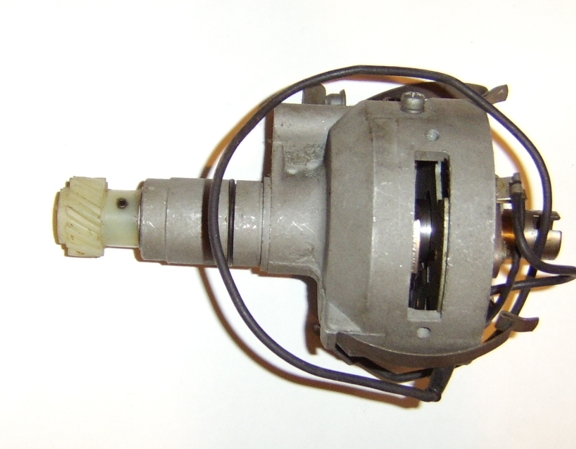
Below: Here are a couple pictures of OEM distributors with the roll pin hole closer to the gear -- as indicated in the factory drawing.


Certainly this in particular is simply an academic issue. There are people who find it important, however, to research problems like this in order to understand historic design and manufacturing issues.
Recently, a rather disturbing development has come in the form of resistance to the presentation of this type of information by some individuals on internet forums. This even extends to a resistance to allow comparison of the engineering and engineering issues from one engine to another within the same marque and comparison to engines outside the marque even evokes misdirected anger.
This is doubly remarkable given that the very designer of the slant six engine, Mopar legend Willem Weertman, described it as his first clean sheet work and that he used established design elements and principles from earlier engines.
One of the other ways in which this anger is evoked comes from challenging information that these individuals believe to be correct. Correct to the extent that they reject and try to ridicule claims to the contrary outright with no investigation.
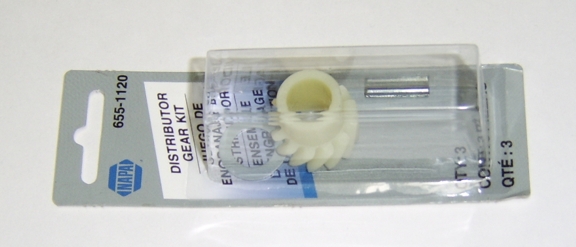
One of these expressed beliefs is that the currently available plastic replacement gears are all the same. To investigate this claim two replacement gear sets were purchased locally: one from a NAPA store and another from an Advance Auto store.
To save time for the reader, this claim was immediately found to be false. The two plastic gears have pilot holes drilled on opposite sides of the gear. Using the pilot hole alone as a guide will result in timing that is off-spec. The distributor can be rotated to correct this but that is not the point. The issue is the resistance to even minimally investigate their beliefs and to be open to being mistaken.

The reader can see that the gear teeth above the slot are shifted. What is difficult to see in the above picture is that the two gears have different mold marks. They are clearly made from different Nylon batches. It is very likely that they were made by completely different companies despite the fact that they both were made in Taiwan.
The critical dimensions do compare well, however, other than the pilot hole being 180 degrees different.
Update 1-11-2010
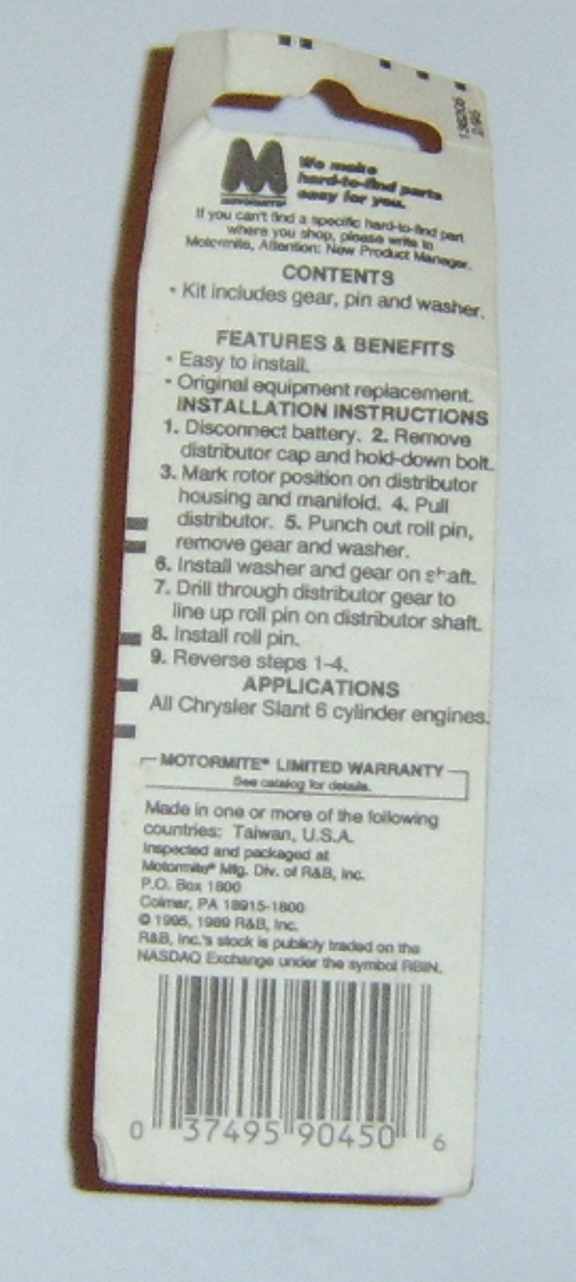
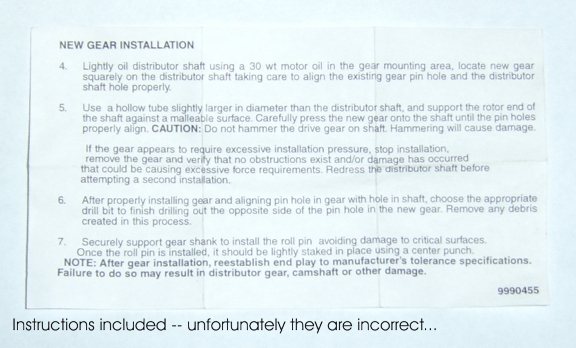
A third distributor gear was purchased on eBay and arrived today. This gear is different still from both previous gears. The diameter of the roll pin hole in the gear is smaller than the other two. This gear also includes installation instructions -- but two different sets.
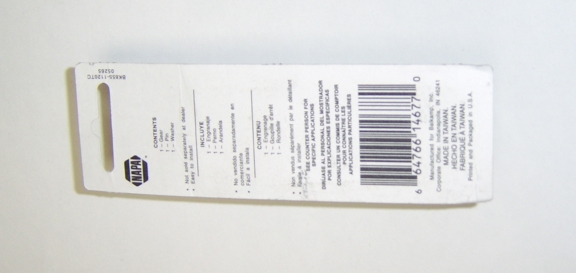
On the back of the box the instructions are ambiguous as to whether a new hole through the shaft should be drilled or not. One should be -- the factory specified end play needs to be .007" though this information is not provided.
Inside the package another installation instruction sheet is provided -- no matter that it is the instruction sheet for a Ford 90455 gear and incorrect.
So far, the evidence is strikingly in support of the idea that some sort of early error in communication or manufacturing occurred. Again, this appears to be an industry wide problem.
   
Additionally, a now rare NOS slant six service distributor shaft from Mopar was located on eBay and purchased for closer examination. This service shaft has no roll pin hole drilled whatsoever. This is consistent with the factory recognizing that multiple hole drilling locations exist -- indeed the factory illustration itself shows two.
  
Update 1-14-2010
A vintage rebuilt distributor was purchased on eBay for closer examination. This rebuild was performed for Mopar by an independent company. There are many dramatic differences to be noted.
  
There is zero end-play for the gear which is in contradiction to the Factory Service Manual. The gear was then removed to examine it and the shaft.

There is but one drilling and it does not line up with the later replacement gear holes whatsoever. This indicates that a new undrilled service shaft (seen earlier) had been installed and a random drilling location chosen.
There are numerous significant differences between this earlier gear and the later replacement gears. The width of the gear section itself is greater, .425" versus .415" :

The total overall length of the gear with bushing is the same but the gear section is closer to the base of the distributor when mounted by ~ .015" :

The gear teeth are different in a number of ways: the bottom land is deeper and so the flank and fillet are also changed; the earlier gear teeth are much more consistent in shape. The earlier gear has other finishing points as well that indicates it is a more precise product. This extends to the roll pin which looks to be of higher quality steel and the spacer washer which is surfaced on both sides and does not have the sharp edge from being punched out.
It is clear that the problems described by the Ford Racing catalog were very much present at Mopar as well -- even within their own authorized rebuilders. More significantly, it is clear that the designs of the replacement gears currently being offered are different from the earlier replacement gears authorized by the factory.
Anecdotally, it is very interesting that all four service gears examined so far have been different.
Update 1-15-2010
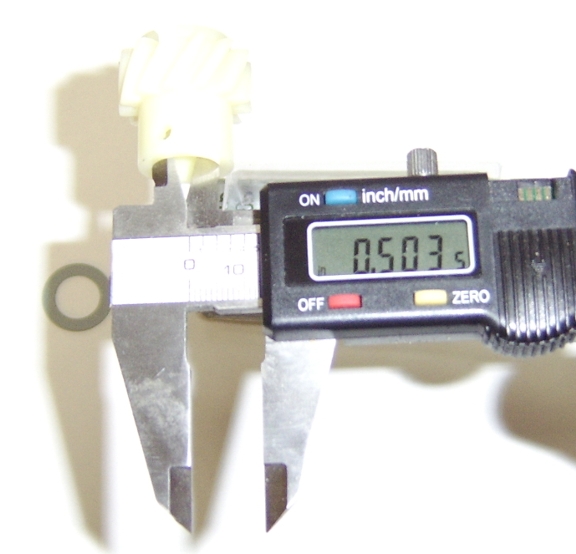
During the checking of some dimensions it was noted that the distributor gear has a large amount of clearance with the shaft (.505" - .497" = .008") which would increase with normal operating temperatures. The FSM specifies end play and this would allow the gear to rock back and forth using the roll pin as a pivot. This movement would introduce spark scatter. In a high level competition engine this would be unacceptable and, moreover, preventable by simply using dual roll pins rather than a single roll pin. It seems reasonable that this is why dual roll pins were illustrated in the drawing from Chrysler as there was initially a large interest in competing with the slant six by the factory.
~~~~~~~~~~~~~~~~~~
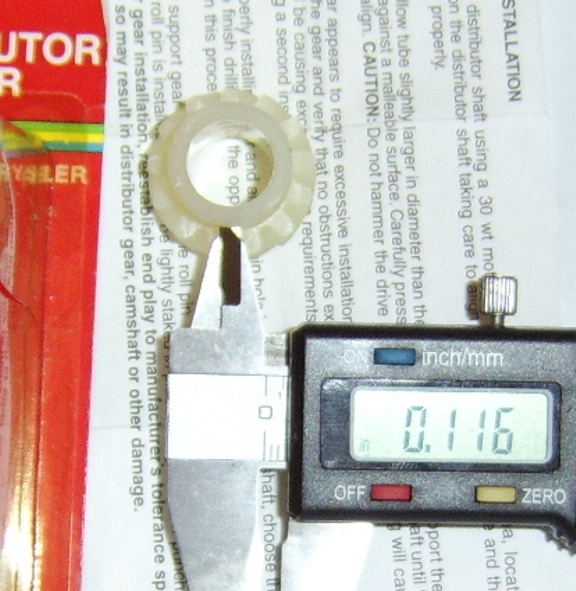
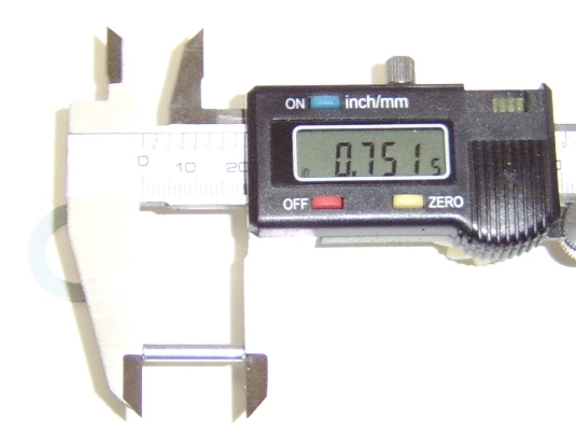
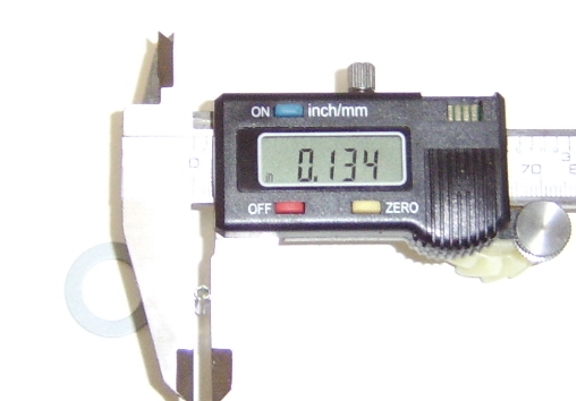
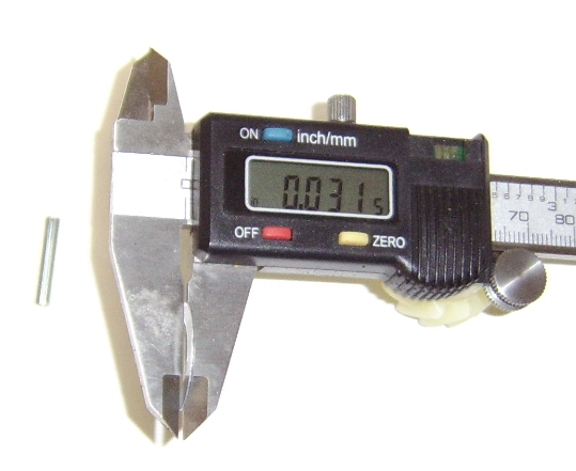
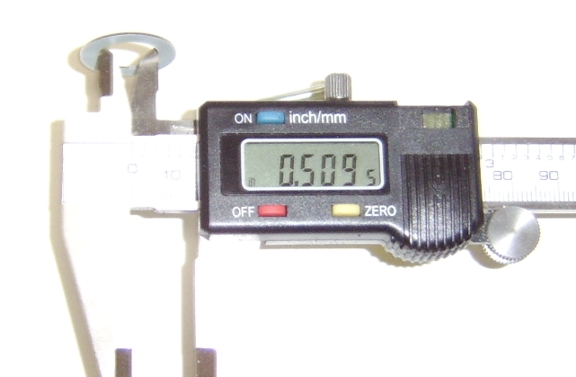
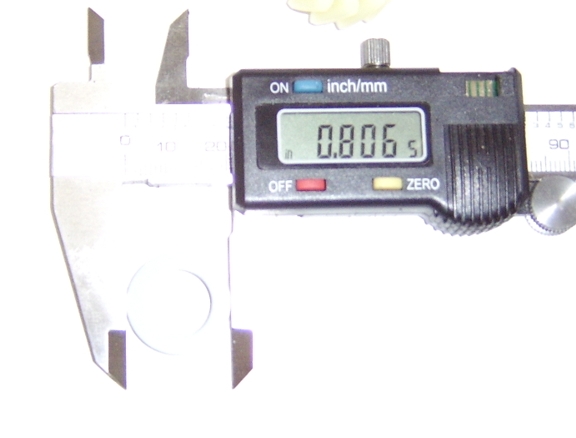
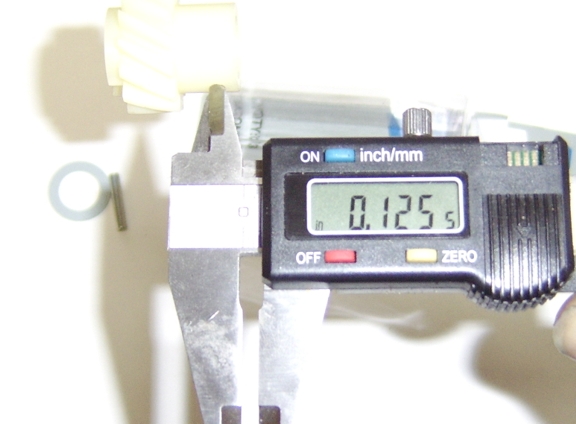
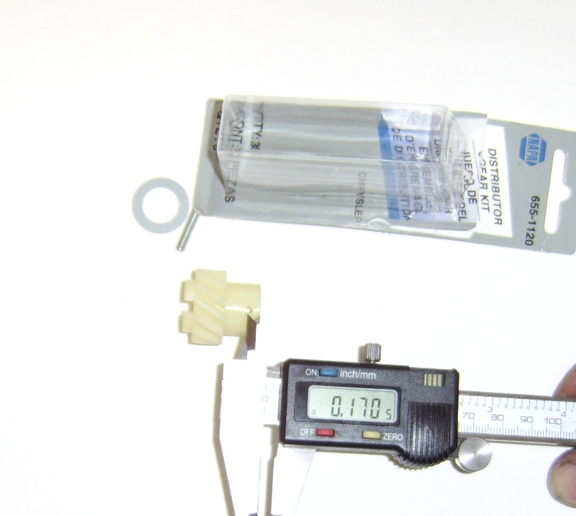
Below are some pictures of critical dimensions of the gears; there are 13 teeth. Hopefully these will prove useful to someone looking for a possible metal gear that is still in production. Maybe even from another marque...


|








 World Wide!